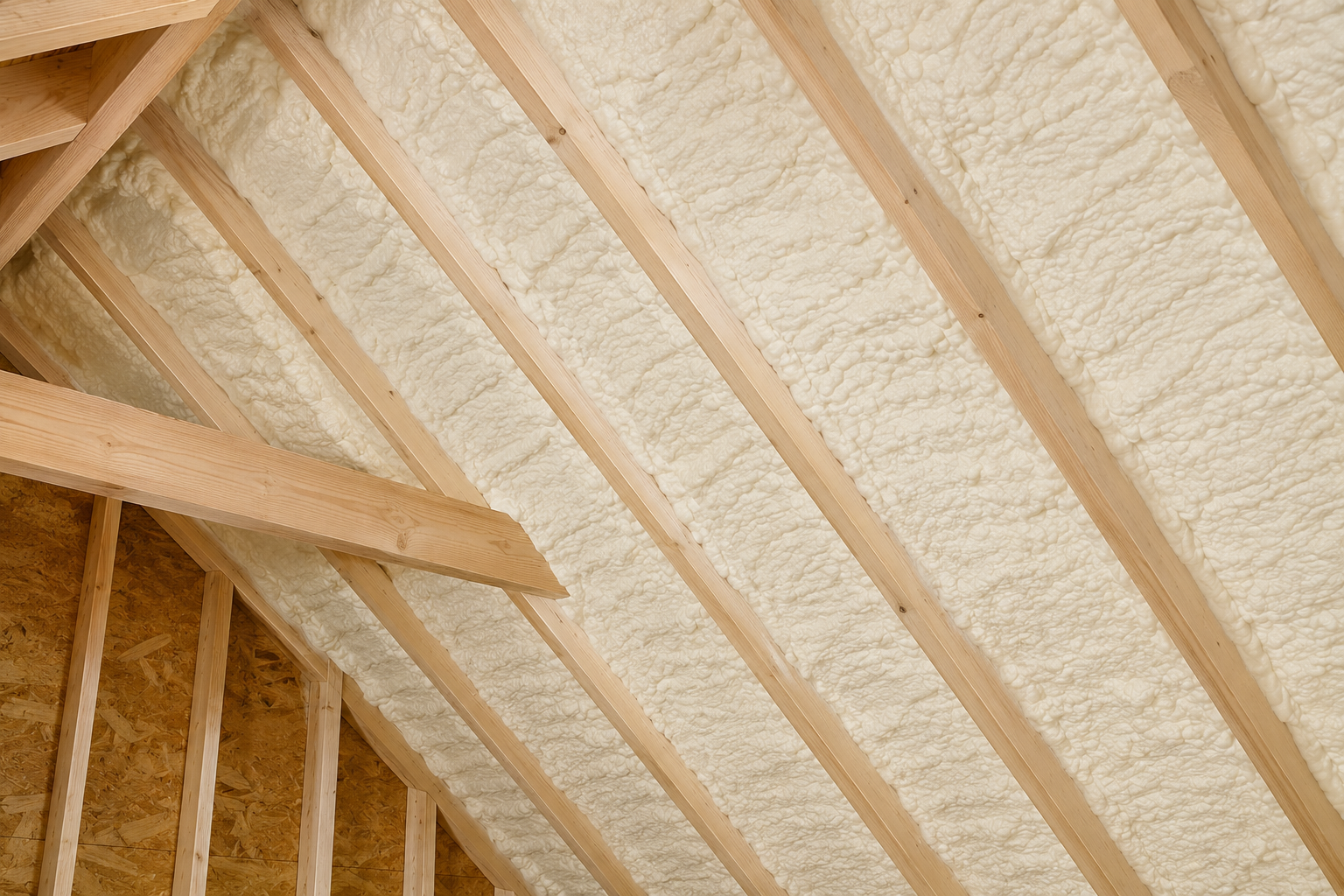
At AF Credit, we can consider lending where the spray foam issue is capable of being rectified and the borrower has obtained a clear quotation for the works. In simple terms: if the problem can be costed, removed or remediated, a bridging loan may allow the purchase or refinance to proceed.
Why Does Spray Foam Insulation Cause Mortgage Problems?
Spray foam insulation is often installed in lofts, attics and roof spaces to improve energy efficiency. However, mortgage lenders can be cautious because spray foam may make it harder for surveyors to inspect the roof structure.
The main lender concerns are:
- The roof timbers may be hidden from view
- Damp, rot or decay may be concealed beneath the foam
- Ventilation within the roof space may be reduced
- Moisture may become trapped against timber structures
- Removal can be costly
- Future buyers may struggle to obtain a mortgage
This is why a property with spray foam insulation may be described as difficult to mortgage, unmortgageable or unsuitable for standard mortgage lending.
Open-Cell vs Closed-Cell Spray Foam
There are two main types of spray foam insulation: open-cell and closed-cell. Understanding the difference matters when assessing the likely impact on mortgage lenders.
Softer and less dense. Generally considered more breathable than closed-cell foam, but can still cause mortgage issues if it prevents inspection of the roof structure or if installation paperwork is incomplete.
Harder, denser and more rigid. Can act as a vapour barrier, restricting ventilation and increasing concerns around trapped moisture. Particularly problematic where applied directly to roof tiles, slates, felt or timbers.
Can You Get a Mortgage with Spray Foam Insulation?
Sometimes, but it depends on the lender. Some mortgage lenders may decline automatically if spray foam is present. Others may consider the application if the borrower can provide suitable documentation, including:
- Details of the spray foam product used
- Installation certificates
- Building regulation or compliance documentation
- Surveyor comments
- Evidence that the roof timbers remain inspectable
- A specialist report confirming the installation is low risk
However, many buyers only discover the problem after the valuation or survey has been carried out. At that point, the mortgage offer may be withdrawn or the lender may refuse to proceed — often at a late stage in the transaction.
What Can You Do If Your Mortgage Is Declined Because of Spray Foam?
If your mortgage has been declined due to spray foam insulation, you usually have three options:
Find another mortgage lender willing to consider the property — though the choice is limited and success is not guaranteed.
Ask the seller to remove or remediate the spray foam before completion — though this depends on the seller's willingness and the time available.
Use a bridging loan to complete the purchase, remove the spray foam after completion and then refinance onto a mortgage once the property is acceptable to mainstream lenders. For many buyers, this is the most practical route.
How AF Credit Can Lend on Properties with Spray Foam Insulation
AF Credit can consider bridging finance where the borrower can show that the spray foam issue will be rectified. In many cases, all we need is:
- A quote from a contractor to remove or remediate the spray foam
- Confirmation that the works are affordable and deliverable
- A clear exit strategy — typically refinancing onto a standard mortgage once the works are complete
- Evidence that the property should become mortgageable once the issue is resolved
This allows the buyer to complete the purchase, carry out the works and then refinance onto a standard mortgage once the spray foam issue has been dealt with.
Buying a Property with Spray Foam Insulation Using a Bridging Loan
A bridging loan can be used where a mainstream mortgage lender will not currently lend. The process typically works as follows:
The issue is usually picked up during a survey, valuation or legal due diligence process — often at a late stage in the transaction.
The borrower obtains a quotation from a suitable contractor confirming the cost of removing or rectifying the spray foam insulation.
We assess the property, the proposed works, the loan amount and the exit strategy. We consider each case individually rather than applying blanket restrictions.
The bridging loan allows the borrower to complete the purchase even though a standard mortgage lender will not currently lend against the property.
The spray foam is removed or remediated in line with the agreed quotation. Where broader works are also required, AF Credit can consider refurbishment finance alongside the bridging facility.
Once the issue has been resolved, the borrower refinances onto a residential mortgage, buy-to-let mortgage or exits by selling the property.
Example: Mortgage Declined Due to Spray Foam Insulation
A buyer agrees to purchase a property for £300,000. The mortgage valuation identifies spray foam insulation in the loft. The lender declines the mortgage because the roof timbers cannot be properly inspected.
The buyer obtains a quote for £8,000 to remove the spray foam and inspect the roof structure. AF Credit agrees to provide a bridging loan, allowing the buyer to complete the purchase.
After completion, the spray foam is removed, the roof is inspected and the property is refinanced onto a standard mortgage. Without specialist finance, the purchase may have fallen through entirely.
Why Spray Foam Properties Can Be an Opportunity
Most buyers searching for property are reliant on a mainstream mortgage. The moment a lender flags spray foam insulation, they are out. That single issue — often a few thousand pounds to resolve — removes the majority of the buying market from the table.
For buyers with access to bridging finance, this creates a genuine and repeatable opportunity.
The Strategy: Buy at a Discount, Fix, Refinance
The discount you negotiate on purchase — driven by the reduced buyer pool — often significantly exceeds the cost of removal. The spray foam is not the problem. It is the opportunity.
The Numbers Work in Your Favour
Consider a property with an open market value of £250,000. Because a mainstream mortgage lender has declined, the seller's pool of potential buyers is limited to cash buyers and those with access to specialist finance. The seller needs to move. You negotiate a purchase price of £215,000 — a £35,000 discount on open market value.
The spray foam removal costs £6,500. Total spend: £221,500. Once the works are complete, you refinance onto a standard mortgage at the full open market value of £250,000. You have gained approximately £28,500 in equity — before accounting for any wider market appreciation — simply by being the buyer who could complete when others couldn't.
Not every case produces figures like this. But the principle — a resolvable problem creating a discounted entry point — applies consistently across the market.
Why This Opportunity Is Repeatable
Spray foam insulation was installed widely across the UK, often under government-backed energy efficiency schemes. The number of affected properties is significant. Lender attitudes have hardened over the last two to three years and show no signs of reversing in the near term.
This means the pool of discounted, spray-foam-affected properties is not shrinking. For investors with access to bridging finance and a straightforward removal strategy, this represents a consistent source of below-market-value residential stock — in areas and at price points that would otherwise be highly competitive.
- Buy a property that other buyers simply cannot finance
- Negotiate a materially better purchase price due to the reduced buyer pool
- Complete quickly and with certainty — giving you an edge in negotiation
- Resolve the spray foam issue on your own timeline after completion
- Refinance onto long-term, lower-cost mortgage finance once the property is clean
If your mortgage has been declined because of spray foam insulation, or you are buying a property with spray foam in the roof, AF Credit may be able to help. Where the issue can be rectified and you have a quote for the works, we can consider bridging finance to help you complete the purchase and exit once the property becomes mortgageable again.
Get indicative terms